
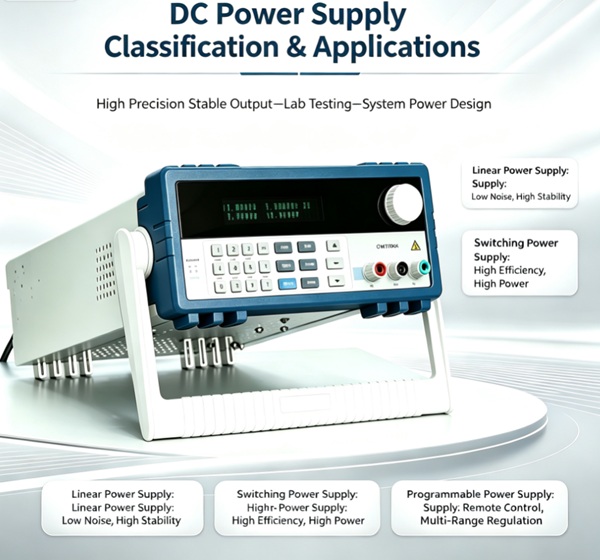
Classification of DC Regulated Power Supplies
With the advancement of science and technology, the structural design and control circuits of power supplies have been continuously upgraded. High-frequency switching circuits and intelligent digital control have become major development trends for power supply equipment. A DC regulated power supply is an instrument with controllable voltage output, whose core functions include AC-DC conversion, voltage transformation and current regulation. So how can DC regulated power supplies be classified according to different characteristics?
System DC Power Supplies
System DC power supplies are mainly used in power supply design for low-voltage electrical appliances. Generally speaking, they feature simple functions, high output power and large output current ranging from several amperes to dozens of amperes. They can supply power to multiple electrical devices to cope with heavy power loads. The design priority of such power supplies lies in long-term continuous and stable operation, while output voltage drift and voltage regulation accuracy are secondary considerations.
For certain special basic systems, the power supply adopts a fixed output voltage design without voltage adjustment buttons on the operation panel. Some special system power supplies are even not equipped with ammeters for output monitoring, and such models are commonly used by amateur radio enthusiasts.
Adjustable DC Regulated Power Supplies
The most prominent feature of adjustable DC regulated power supplies is variable output voltage. Thanks to adjustable voltage output, they boast a wide range of applications and are widely deployed in laboratories and equipment maintenance workshops, hence also named “maintenance power supplies” and “laboratory power supplies”.
Products for laboratory and maintenance scenarios are equipped with multiple practical additional functions such as adjustable current limiting and tracking output. The current limiting function is highly practical: users can set the maximum output current of the regulated power supply. When the output current exceeds the preset threshold, the output voltage will drop and the current will stop rising, switching to constant current mode.
Some power supplies are equipped with overcurrent protection. Once the current exceeds the preset value, the equipment will activate protection mode and cut off output; a power cycle is required to restore normal output. Short circuits may occur due to misoperation or circuit faults during experiments and maintenance, and the current limiting protection function can effectively avoid related damages.